
UPCOMING
July 18 - August 29, 2026
Internalized Landscapes:
I can feel this place in my bones
Curated by: Alicia Renadette
Participating Artists:
May Babcock
Alex Callender
Merill Comeau
Karin Gielen
Michael Gunn
Maggie Nowinski
Kendall Reiss
Shey Rivera Ríos
Amanda Russhell Wallace
Opening Reception
Saturday, July 18, 2026
3:30 - 5:30 pm
Artists Talks:
Saturday, August 1
Merill Comeau, Alex Callender, Karin Gielen, Maggie Nowinski, Kendall Reiss
4:30 - 6:00 pm
Saturday, August 15
May Babcock, Michael Gunn, Shey Rivera Ríos, and Amanda Russhell Wallace
4:30 - 6:00 pm
“Internalized Landscapes: I can feel this place in my bones” isan exhibition of nine artists working across diverse mediums – painting, drawing, glass, paper, textiles, installation, video and collage – to expand our concept of the landscape. Through scholarly investigations, intimate and somatic interpretations, and intentional interactions with the natural world, the artworks in this exhibition reveal ways in which familiar landscapes are intertwined with our sense of belonging.
Rather than depictions of bucolic views observed from a distance, the artists in “Internalized Landscapes” consider their surroundings at close range. Personal, experiential, and cathartic connections to the natural world as sources of solace, refuge, and wonder, are interspersed with works that consider the lasting impacts of the extraction of natural resources, and the migration of people and plants.
Connections between the environment and the body appear throughout the exhibition. Maggie Nowinski’s intricate pen and ink drawings recall empirical scientific illustrations, but in fact, render speculative hybridizations of anatomy and botany. These high-contrast, impossible networks of vines, veins, leaves, muscle, fruit, and bone, reimagine and embody biological strategies for growth and transformation. In her series “Welling”, Amanda Russhell Wallace collages stratified layers of medical scans, photographs of the body, and spectral shadows cast by oil well derricks - similar to those that disrupt the skyline near where her maternal ancestors were born in Texas. The resulting images, appearing as both cross sections of a dig site and a complex autopsy report, investigate the prevalence of biological weathering linked to systemic racism, poverty, and environmental stressors.
Michael Gunn creates fantastical, hallucinatory narrative paintings that imagine secluded sites of enchantment and intimacy for queer people to safely immerse themselves in. Gunn excavates layers of his own paintings, dissolving them to reveal the glowing bodies of men doubling as vessels from which wild and abundant gardens may be propagated to provide both beauty, possibility, and shelter. Alex Callender’s paintings in her series “American Lawn” and “Night Grass” often prominently feature disembodied arms and hands emerging from beneath swaths of deep blue fabric that resembles both indigo-dyed textiles –a once-lucrative cash crop cultivated by enslaved people- and plastic tarps – a familiar material associated with the aftermath of climate disasters.
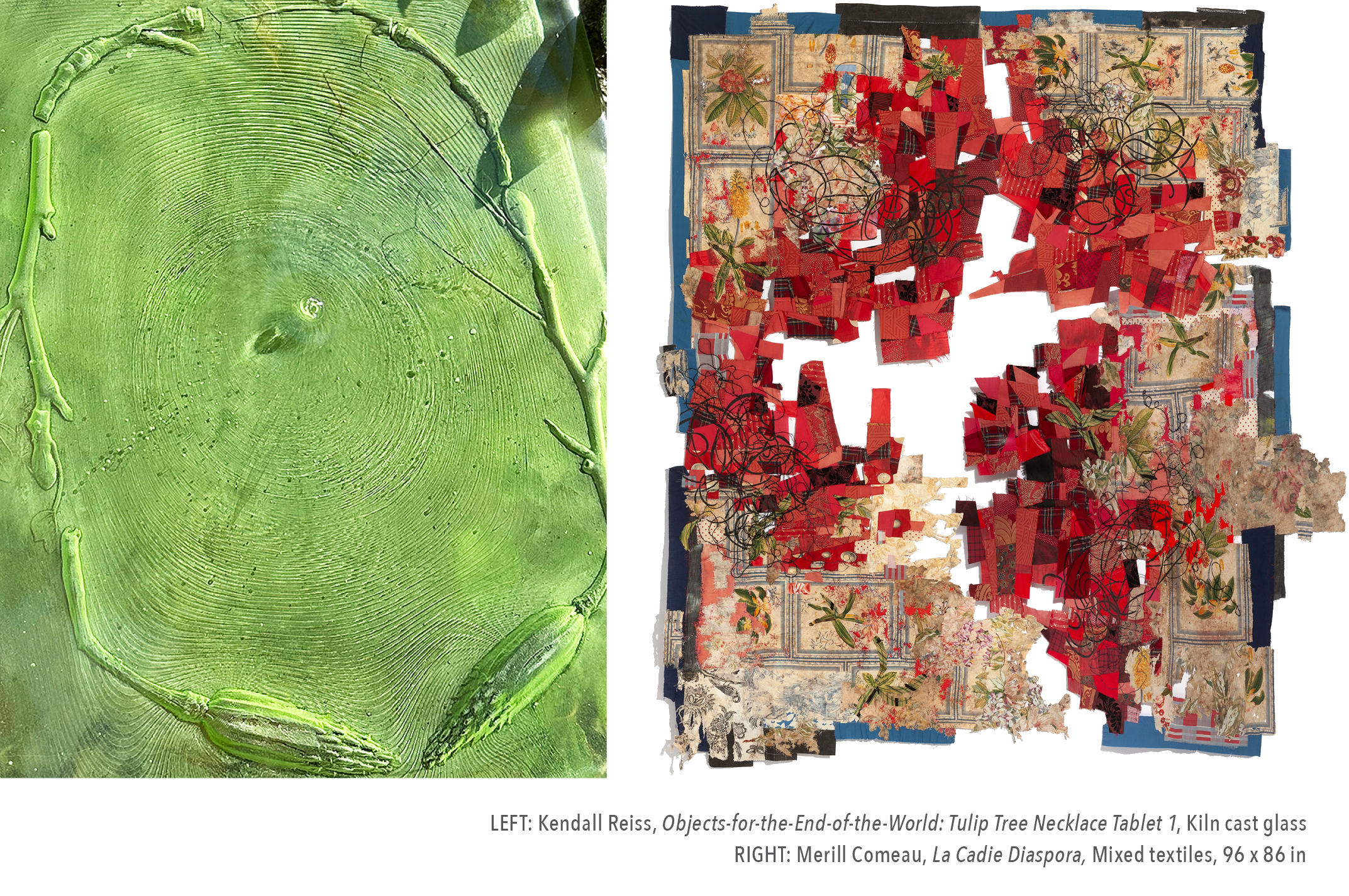
Another work that engages with personal family ancestry and colonial history is “La Cadie Diaspora” by Merill Comeau. This substantial wall hanging features a ruptured patchwork of red fabric surrounding a gaping, wound-like void. A disjointed framing of decaying French botanical fabrics are overlaid with spirals of black fibers that “ trace confused and crossed wanderings” evoking the routes taken by the Acadians of Nova Scotia—ancestors of the artist—after their expulsion in the 1700s.
Kendall Reiss and May Babcock each connect with the natural world through rigorous investigation and transformation of plant matter. Reiss’ contemporary jewelry series “Objects-for-the-End-of-the-World” comprises necklaces she creates using segments of delicately carved tree fragments and seed pods from ancient Magnolia and Tulip trees, as well as luminous, tablet-sized glass casts of these necklaces – fossilized in a circular arrangement that suggests the cyclical nature of life cycles. To create Babcock’s series “New Ecologies” , she immerses herself in the landscape and collects fibers from plants and seaweeds she finds thriving in distressed lands and waters. She reconstitutes the fibers into paper pulp that is layered onto discarded electrical and communication wire and sculpted into novel, imagined amalgamations.
Both Karin Gielen and Shey Rivera Ríos embrace practices of ritual and research in their distinct approaches. As part of her ongoing project “This Is Not a Boat”, Gielen - who immigrated to the United States from Belgium- integrated her daily practice of walking the shoreline with a list of pre-determined actions she performed in the landscape with small boat forms made from wax paper and fabric. The boat forms become proxies for the artist as their fragile forms must navigate rough terrain and encounter adverse conditions of snow, ice, water, wind, fire, and more. Presented through field notes, video, photography and an ephemeral archive of the experiments, the work is mounted as documented evidence of an investigation of endurance and longing. Rivera Ríos uses a mejunje (mix) of digital art, performance, and installation, creating works such as futuristic altars and, more recently, heavily annotated archival images from their family’s home and farm. A new work “La tierra que me habita (the land that lives within me)” is a sculpture made up of sublimated photographs on cotton fabric, hung with metal, wire, twine, and wooden clothing clips. The images are photographs from Rivera Ríos’ own personal archive of their returns to Puerto Rico over the past 15 years, including photographs that belong to a series called "fruta de la tierra (fruit of the land)" which consists of images of their hand holding various types of fruit from Borikén (Puerto Rico).
The artists in this exhibition come from a wide variety of lived-experiences and origins, yet share a collective awareness of the landscape as more than a bucolic backdrop. Rather, they consider it as a series of interconnected systems that are deeply embedded in our culture, memory, and the subconscious. Through their varied approaches, they reflect on how our natural surroundings continue to shape our perceptions of ownership, belonging, and legitimacy. They invite us to reconsider what it means to belong in, or to, a place.
-
112 Van Zandt Ave.
Newport, RI 02840There is parking in front of the building as well as on the street. Please be respectful of our neighbors.
-
Please contact Susan Matthews
overlap@overlapnewport.com